What is Progressive Overload, Really?
By Boston Naviaux, founder of Lift Dungeon · Published May 19, 2026 · Updated October 17, 2026 · 5 min read
Progressive overload means gradually giving your body more work than it's used to, so it keeps adapting. You can add weight, reps, sets, better form or shorter rest between sets, and any one of them counts. Without it, a body that already handles your routine has no reason to get stronger.
If you've spent more than fifteen minutes on fitness YouTube or in a gym, someone has told you about progressive overload. Usually it sounds something like: "you have to keep lifting heavier weights to grow." Half right, and it leads a lot of people astray.
What is progressive overload?
Progressive overload is the principle of gradually asking your body for more work than it handles now. In one line:
Nothing more is required. Your body adapts to whatever you regularly ask of it. Bench 135 lbs for sets of 8 every week for a year, and at the end of that year you'll be a guy who can bench 135 lbs for sets of 8. Your body has no reason to build more muscle or strength because it's already handling everything you throw at it.
To grow, you have to make the work harder than it was last time. Even a little harder is enough. The American College of Sports Medicine's position stand on progression models says the same: to keep stimulating adaptation toward a training goal, resistance training has to progress.
Does progressive overload only mean adding weight?
No. Progressive overload means making the work harder than last time, and weight is only one of five ways to do it. Most people get stuck because they hear "progressive overload" and assume the only way to apply it is to add weight to the bar every workout. When the weight stops going up, they think they've stalled.
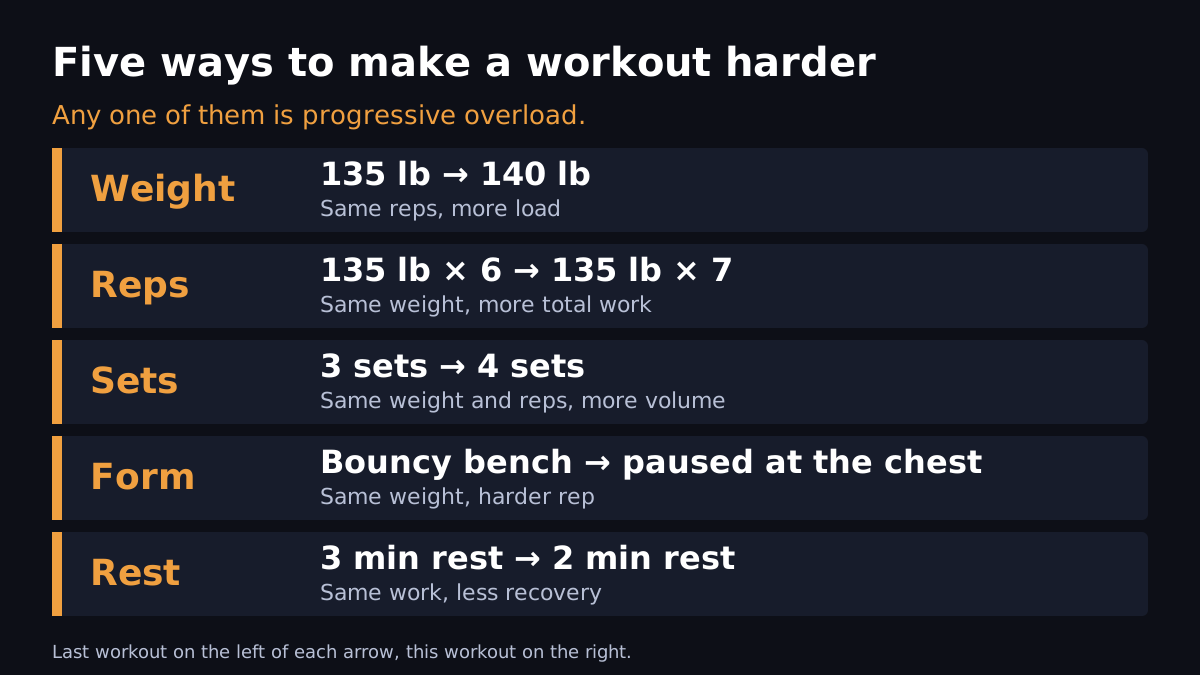
You haven't. There are at least five ways to make a workout harder than the last one:
- Add weight. The obvious one. 135 last week, 140 this week.
- Add reps. 135 × 6 last week, 135 × 7 this week. Same weight, more total work.
- Add sets. Three sets of bench last week, four this week. Same weight, same reps, more volume.
- Improve form. A bench press with a full pause at the chest is harder than a bouncy one at the same weight.
- Shorten rest. If you used to rest 3 minutes between sets and now you can do the same work resting 2 minutes, you got stronger.
Any one of these is progressive overload. Mix and match across a training block. You don't get to do none of them and call it progress, but you also don't have to PR every single session.
Reps are a real lever, not a consolation prize. In an eight-week trial of 43 trained lifters, one group added load at a fixed rep range and the other added reps at a fixed load. Both approaches looked viable for building muscle and strength. The trial compared those two levers only, not sets, form or rest.
What it looks like in a real week
Let's say you're working on your squat. A reasonable, repeatable cycle:
- Week 1: Squat 185 × 3 sets of 5 reps. Felt heavy but you got all the reps.
- Week 2: Squat 185 × 3 sets of 6 reps. Same weight, more reps. That's overload.
- Week 3: Squat 185 × 3 sets of 8 reps. Reps are creeping up, the weight's starting to feel easy.
- Week 4: Squat 195 × 3 sets of 5 reps. Weight goes up, reps reset. Cycle restarts.
You didn't add weight every single session, but at the end of four weeks you're squatting 10 lbs more than you started. Progressive overload is boring and slow, and it is how lifters keep getting stronger.
Why people don't actually do it
The hard part isn't understanding the concept. The hard part is the bookkeeping.
To overload progressively, you need to know exactly what you did last time. Same exercise, same set number: what weight, how many reps, how it felt? If you can't answer that, you can't progressively overload. You're just guessing.
Lifters who write everything down in a notebook (or an app) can see whether they progressed, and lifters who freestyle can't tell. The bookkeeping is the whole game.
When overload doesn't work
Three situations:
- You're under-recovered. Sleep, food, and stress are upstream of strength. If those are wrecked, you can't overload anything; your body's already maxed out on stress.
- You're a long-tenured lifter. After enough years, even a textbook program stops adding weight every cycle. That's normal. Intermediate and advanced lifters expect to add ONE rep or 1-2 lbs per session and consider it a great session.
- You're trying to overload everything at once. You can add weight OR reps OR sets, not all three in the same session. Pick one variable per cycle.
The shortest summary possible
Give your body slightly more work each session than the last. Track every set so you know what "slightly more" means. Cycle which variable you push (weight one phase, reps the next). When you stall, look at sleep and food before you look at the program.
Progressive overload comes down to that. Everything else is detail.
Tracking is the hardest part. We do it for you.
Lift Dungeon is the lifting RPG: a rule-based engine logs every set, picks your next workout from your history, and auto-progresses the load, wrapped in a game where you level a pixel-art character, fight every exercise as a monster in Dungeon Mode, and lift live with friends in co-op parties. Free on iPhone, with optional Pro ($9.99/month or $59.99/year) and Ultimate ($14.99/month or $89.99/year) subscriptions for longer history, bigger parties and extras.
Download free